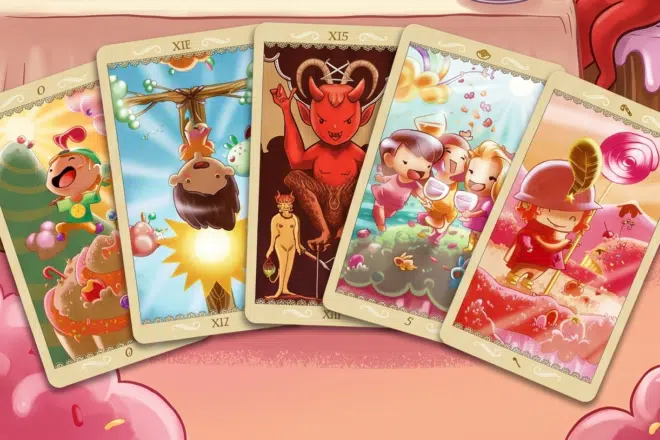
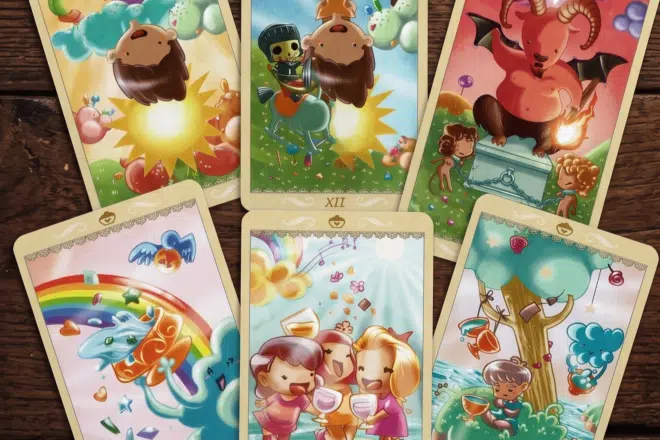
Die Schwerter stehen für menschliches Denken, Kommunikation und Logik. Die Reise des Narren durch diese Farbe beginnt mit der „Entdeckung der Wahl“ im Ass der Schwerter und endet mit Strategie und Entschlossenheit, verkörpert durch die Königin und den König der Schwerter.
Die Schwerterkarten in einer Legung
Wenn in einer Legung eine Karte aus der Farbe der Schwerter erscheint, fordert sie Fragesteller*in und Leser*in dazu auf, die Frage oder das Anliegen zu analysieren und zu verstehen. Wie jede menschliche Erfahrung hat auch sie positive und negative Momente. Diese Karten behandeln die positiven und negativen „Geist“-Archetypen, die wir alle irgendwann auf unserem Lebensweg durchlaufen.
Schwerter-Tarotkarten und Astrologie
Die Hofkarten jeder Farbe repräsentieren das Element und drei der Zeichen. Der Bube der Schwerter steht für das Element Luft und die ungerichtete, aber kraftvolle Energie menschlichen Denkens und der Vorstellungskraft. Die Figur auf der Karte wird oft als Jugendliche*r dargestellt – und das zu Recht, denn die Jugend ist von einer starken Energie erfüllt, die „überall zugleich“ ist.
Der Ritter der Schwerter steht für Zwillinge, das veränderliche Luftzeichen des Tierkreises. Neugierige, anpassungsfähige Luftenergie treibt ihren Primärantrieb an. Ihre Lebensweg-Energie wirkt am besten, wenn sie Aufgaben erledigen, die ihren Geist auf vielfältige Weise stimulieren; sie müssen lernen, sich bei Bedarf zu fokussieren, um ihre besten Ergebnisse zu verwirklichen.
Die Königin der Schwerter steht für Wassermann, das fixe Luftzeichen des Tierkreises. Unkonventionelle, beständige Luftenergie treibt ihren Primärantrieb an. Ihre Lebensweg-Energie wirkt am besten, wenn sie authentisch und kompromisslos sind; sie müssen stille Standhaftigkeit lernen, um ihre besten Ergebnisse zu verwirklichen.
Der König der Schwerter steht für Waage, das kardinale Luftzeichen des Tierkreises. Analytische, aktive Luftenergie treibt ihren Primärantrieb an. Ihre Lebensweg-Energie wirkt am besten, wenn sie logisch handeln; sie müssen lernen, auch Gefühle einzubeziehen, um ihre besten Ergebnisse zu verwirklichen.
Bedeutungen der Schwerter-Tarotkarten
Ass der Schwerter
The Ace of Swords represents new thoughts, new ideas, and new decisions. This card appears in a reading when it is time to decide, think outside the box, or use logic to address a relationship or situation.
Zwei der Schwerter
The Two of Swords represents detached decision-making. When this card appears, you need to “be at peace” with your choices. There is no need to “look back” at past choices. Rather you need to assess what choices you need to make going forward.
Drei der Schwerter
The keywords for the Three of Swords are sorrow and frustration. This card is the archetype for situations and relationships where we get something we want, but there is a serious problem. A simple example would be getting your dream job but having a terrible boss. When this card appears in a reading, you must learn how to manage a difficult situation.
Vier der Schwerter
The Four of Swords represents the mind “at rest”. When this card appears in a reading, you need to find a way to enter a meditative state regarding a relationship or situation. Detaching and finding a quiet place to contemplate will help you address your concern.
Fünf der Schwerter
The keyword for the Five of Swords is defeat. We all face setbacks; they are inevitable. How we handle them and go on is the real mental test. Failure is an important life lesson, both the nature of it and how we understand what the defeat means for us and others.
Sechs der Schwerter
The Six of Swords represents moving from “one shore of thinking” to “another way of understanding.” This card appears to remind us that we must “cross the in-between” before we are fully out of an old way of thinking and adjusted to a new way of thinking.
Sieben der Schwerter
The Seven of Swords represents either theft or a lack of appreciation, which requires taking one’s talents elsewhere. If you see the card and think of the figure as stealing ideas, then where do you face a betrayal, or who are you betraying? If you see the card and think you are under-appreciated, then you should consider taking your talents elsewhere.
Acht der Schwerter
The keywords for the Eight of Swords are anxiety and doubt. One of the worst limitations we face is doubt. because we find our mind is working against us. We receive this card when we need to make a significant change to our thinking because we are caught in a terrible, negative loop.
Neun der Schwerter
The Nine of Swords represents cruelty, and is a warning card. When this card appears, you need to protect yourself and be on guard, especially against people who will try to make your doubt yourself and who want to see you fail. It can also be a card you draw that is demanding you address any cruelties you have inflicted on others.
Zehn der Schwerter
The keyword for the Ten of Swords is ruin. We all face some situation or relationship that becomes broken beyond repair. This card calls on us to look at a situation or relationship that is headed towards ruin or already ruined. You need to make entirely new decisions and realize there is no fixing the problem (but by moving on).
Bube der Schwerter
The Page of Swords represents the open mind and imagination, which can be wonderful and overwhelming. Thoughts are flying around and need focus. It is great to have many ideas, but unhelpful if none of them lead to any concrete decisions, or constant indecision.
Ritter der Schwerter
The Knight of Swords represents the focused mind, on a quest to take an idea and see that it is achieved. When this card appears in your reading, be decisive and act accordingly. This is no time for doubt.
Königin der Schwerter
The Queen of Swords represents detached, strategic thinking. She is the chess player thinking five or ten or fifteen moves ahead. She will not be swayed by emotion, only by logic and analysis. When she appears in a reading, you need to follow your head, not your heart.
König der Schwerter
The King of Swords represents wisdom and intelligence. He is the “final arbitrator”. When this card appears in a reading, then you assert yourself as the one in charge of the decision-making. If you realize the card is about reacting to a decision from someone with more power than you, then how do you need to “answer” the situation?